
Has Trump Already Won?
President Biden's narrow path to victory
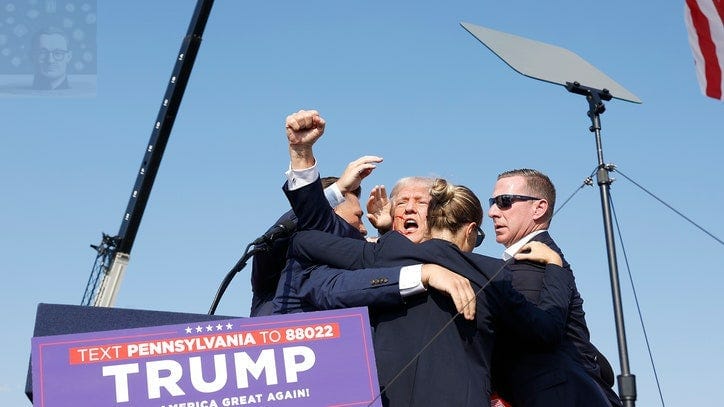
When we began writing this report about a month ago, our working title was: "Biden’s Path to Victory." However, an unprecedented assassination attempt on former President Donald Trump has profoundly altered the trajectory of the 2024 presidential race. Trump's survival, against odds, has energized his base and reshaped political dynamics across the spectrum.
This event has also compelled us to change our headline, seemingly predicting a Trump win. Yet, despite these events, our analysis remains unchanged. We still believe Biden has a narrow path to victory, and this path has not significantly shifted after recent developments.
Strategic Insights Report is a reader-supported publication. To receive new posts and support our work, consider becoming a paid subscriber.
We conducted interviews with several senior analysts, policy experts, and academicians and came to a clear conclusion: despite Trump's considerable momentum, it's not all over for Biden. “To win an election, you have to do two things: securing votes from your supporters and depressing turnout for your opponent. It's the latter where the assassination attempt complicates matters for Biden's team,” commented a Democratic politician. However, some analysts argue that Biden might not need to do much; as a highly respected professor of political science at NYU notes, "The overconfidence among Republican voters will automatically depress their voting. Within the bubble of MAGA politics, many now believe in the Hand of God, and don't think they need to vote for Trump to win."
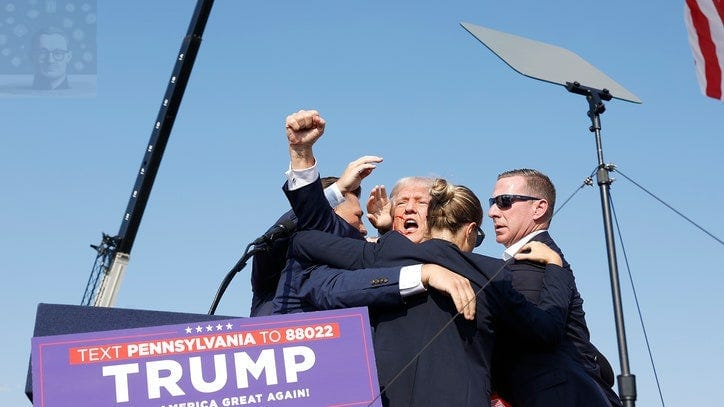
A senior political analyst at Harvard University drew a powerful comparison: "It's as if Trump had his Jesus moment. While he didn't literally rise from the dead, surviving an assassination attempt is a profoundly impactful event. It's the kind of narrative that resonates deeply with supporters and could potentially sway undecided voters."
Historical precedents offer some insight into the potential ramifications. Following the assassination attempt on Ronald Reagan in 1981, his approval rating surged from 51% to 68% in less than two weeks, according to Gallup polls at the time. A veteran campaign strategist observed: "We're witnessing a level of energy among Trump voters that's truly unprecedented. It harkens back to the fervor we saw in Reagan's 1984 landslide, but with an added layer of intensity that's difficult to quantify."
The scenes this Friday were dramatic. On the ground, two key observations spell trouble for the Democrats. A political correspondent noted: "First, there's a clear hardening of support and enthusiasm among the Trump base. Second, and perhaps more worrying for the Democrats, is a sense of self-reflection within their own ranks."
Before you continue, please consider supporting our ongoing commitment to meticulous and independent political and business analysis through a paid subscription or by sponsoring a report. We are offering 20% discount on our annual subscriptions in the month of July to mark the independence.
That being said, we are still in the fifth inning; the ballgame is not yet over.
Who Votes?
We put the question many voters and analysts are asking to a respected researcher in Political Science at Columbia University. In a study conducted at Columbia, researchers sought to answer: who really votes in an election? More intriguingly, they explored what might cause a likely voter to stay home. The study identified three key reasons why potential voters might abstain from casting their ballots:
- They think they have won
- They think they have lost
- They are not inspired
The researchers then categorized responses from both Biden and Trump supporters:
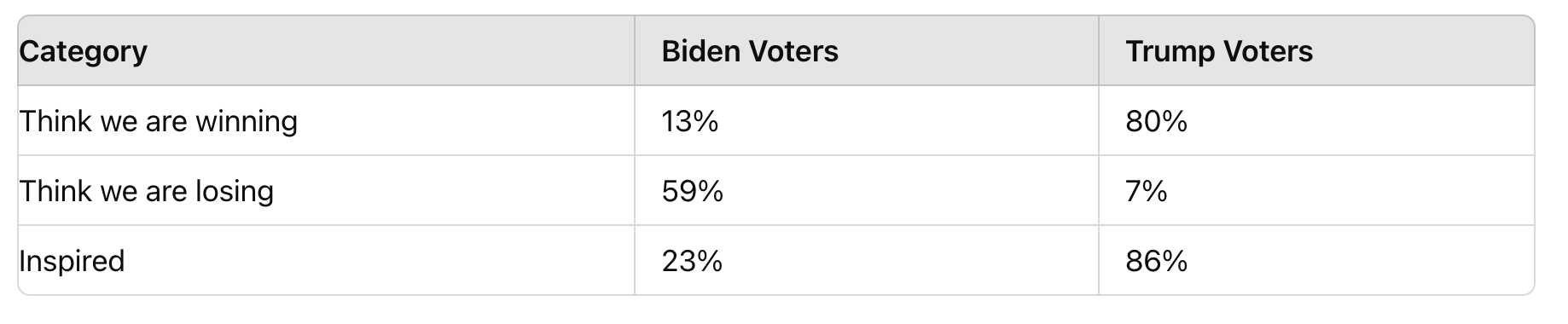
A political psychology professor from Stanford University offered her interpretation: "These numbers tell a fascinating story. Trump's base is highly motivated, but there's a risk of overconfidence, which can lead to lower voter turnout. Look at the turnout in so-called 'safe states,' such as California and New York, where voting consistently is 10-15% lower than in swing states because voters assume their vote is not needed for their candidate to win. This phenomenon was evident in recent Indian and French elections. On the Biden side, we see a lack of inspiration, but also a sense of urgency stemming from the belief that they're behind."
The data presents a complex picture for both campaigns. A seasoned campaign strategist noted: "Trump's numbers are a double-edged sword. High inspiration is great, but the belief that they're winning by such a large margin could lead to complacency. Biden's camp needs to address the inspiration deficit, but the perception of being behind could drive turnout."
The impact of these perceptions on voting behavior cannot be overstated. A voting rights advocate pointed out: "When people think they've already won, they're less likely to endure long lines or navigate complex voting procedures. Conversely, a sense of urgency can overcome a lack of enthusiasm."
A professor of political communication from an Yale highlighted the role of media in shaping these perceptions: "The narrative of a 'close race' or a 'clear leader' can significantly impact voter turnout. We've seen instances where early calling of elections in western states affected voter behavior."
The psychological aspect of feeling like part of a winning or losing team also plays a crucial role. A social psychologist specializing in group dynamics explained: "There's a natural human tendency to want to be on the winning side. This can lead to bandwagon effects, where people are more likely to vote for who they perceive as the winner. However, for some voters, the underdog status can be a powerful motivator."
The data also reveals a stark contrast in the levels of inspiration between the two camps. A veteran pollster commented: "The inspiration gap is significant. It suggests that Trump has succeeded in creating a narrative that resonates deeply with his base, while Biden is still struggling to generate the same level of emotional connection."
However, a political historian cautioned against reading too much into these numbers: "Throughout history, we've seen that inspiration isn't everything. Lyndon Johnson wasn't particularly inspiring in 1964, but he won in a landslide. Sometimes, voters are motivated more by pragmatism than passion."
The implications of these findings for campaign strategy are significant. A Democratic strategist admitted: "We're aware that we need to do more to inspire our base. But we're also focusing on the message that every vote counts, especially given the perception that we're behind."
On the Republican side, a party official expressed a different concern: "Our challenge is to maintain this high level of enthusiasm while also conveying the importance of actually turning out to vote. We can't afford for our supporters to think the election is in the bag."
Voter Turnout: The Decisive Factor in Elections
The assassination attempt on former President Donald J. Trump has undeniably energized his base, but political analysts caution against assuming this enthusiasm will automatically translate into electoral victory. Historical precedents demonstrate that voter turnout, rather than mere enthusiasm, often plays the decisive role in determining election outcomes.
The 2016 presidential election serves as a prime example of how turnout can confound expectations. Many assumed Clinton's apparent lead in enthusiasm metrics would translate to victory. However, Trump's ability to mobilize voters in key swing states ultimately made the difference. Similarly, the 2000 election between Bush and Gore, with its razor-thin margin in Florida, underscores how every vote truly matters. A slight shift in turnout in just a few counties altered the course of American history.
Internationally, the 2016 Brexit referendum offers another stark example. Pre-referendum polls suggested a relatively close race, but with 'Remain' having an edge. The surprise victory for 'Leave' was largely attributed to higher-than-expected turnout among their supporters, particularly in areas predicted to have low participation.
These examples underscore a crucial point made by a campaign strategist with experience in multiple presidential races: "Enthusiasm is important, but it's not everything. The key is converting that enthusiasm into votes. History is littered with passionate movements that failed to translate their energy into electoral success."
As the current election approaches, both campaigns are acutely aware of this reality. A senior advisor to the Republican National Committee stated: "We're not taking anything for granted. The enthusiasm we're seeing is encouraging, but our focus is on ensuring that every supporter casts their ballot." Similarly, a Democratic strategist emphasized their approach: "Our strategy isn't about matching the decibel level of Trump rallies. It's about methodically identifying our voters and getting them to the polls, whether they're fired up or not."
The key question remains: Will the surge in enthusiasm among Trump supporters translate into increased turnout, or will it lead to complacency? A veteran political scientist highlighted this concern: "The increased enthusiasm for Trump may potentially negatively impact turnout. While enthusiasm generally results in higher turnout, overconfidence can lead to complacency."
Recent polling data reveals a nuanced picture. Our latest survey shows that 86% of Trump supporters describe themselves as 'very enthusiastic' about voting, compared to 65% of Biden supporters. However, when we ask about the likelihood of actually voting, the gap narrows significantly. This discrepancy between enthusiasm and voting intention has historical precedents. In the 1948 election, Dewey's supporters were far more vocal and confident, leading to the infamous 'Dewey Defeats Truman' headline. But Truman's less enthusiastic but more numerous supporters ultimately carried the day.
The impact of negative partisanship is another factor to consider. We're seeing high levels of what we call 'negative partisanship'—people motivated more by opposition to the other candidate than support for their own. This was a significant factor in 2016 and appears to be even more pronounced now.
Social media engagement, while not a reliable predictor of electoral outcomes, provides some insight into voter enthusiasm. Trump's online engagement numbers are through the roof. But we've learned from past elections that online buzz doesn't always translate to votes. Biden's support, while less visible online, shouldn't be underestimated.
The scenes this Friday were dramatic. On the ground, two key observations spell trouble for the Democrats. First, there's a clear hardening of support and enthusiasm among the Trump base. Second, and perhaps more worrying for the Democrats, is a sense of self-reflection within their own ranks.
However, a note of caution was sounded by a veteran campaign manager: "Enthusiasm is notoriously difficult to measure accurately. What matters is not just how excited voters are, but how likely they are to overcome obstacles to casting their ballot. In that regard, the picture is much less clear-cut."
As the country grapples with these issues, analysts are working overtime to understand how this unprecedented event might influence voter behavior. A political science researcher from a Midwest university commented: "We're seeing shifts in voter enthusiasm that are reminiscent of the 1968 election, where the assassination of Robert Kennedy and the tumultuous Democratic National Convention had profound effects on voter turnout and party allegiances."
The Final Stretch: Voter Enthusiasm and Election Outcomes
The assassination attempt on Trump has undoubtedly reshaped the political landscape, but its ultimate impact on voter behavior remains uncertain.
A prominent political analyst summarized the situation: "We're in uncharted territory. The enthusiasm gap between Trump and Biden supporters is stark, but history has shown that enthusiasm doesn't always translate into votes. The key question is how these perceptions will influence behavior on Election Day."
The challenges facing both campaigns are distinct. For the Trump campaign, the risk of overconfidence looms large. A Republican strategist acknowledged this concern: "We're working hard to ensure our supporters understand that despite the polls and the enthusiasm, this election is far from decided. Complacency is our biggest enemy right now."
On the Biden side, the task is to turn a perceived deficit into a motivating factor. A Democratic campaign manager explained their approach: "We're framing this as a come-from-behind victory. Every vote counts, and we're emphasizing the power of the individual to make a difference."
The role of undecided and independent voters cannot be overlooked. A pollster specializing in swing state dynamics noted: "In key battleground states, we're seeing a significant number of voters who remain undecided. Their choices, and more importantly, whether they choose to vote at all, could be the deciding factor in this election."
As Election Day approaches, both campaigns are intensifying their get-out-the-vote efforts. A grassroots organizer shared: "We're seeing unprecedented levels of volunteer engagement. People on both sides understand the stakes and are putting in the work to mobilize their communities."
The final weeks of the campaign will be crucial in shaping voter perceptions and enthusiasm. A media analyst observed: "The messaging in these last days will be critical. Both campaigns will be working overtime to energize their bases while also appealing to those crucial undecided voters."
A political strategist within the DNC had a different, but now common thought on what it would take to win against Trump: "Sometimes, winning needs a sacrifice. Is Biden willing to make one?" This alludes to the murmurs that Biden should step down to save the election. However, our analysis suggests Democrats need to put their efforts elsewhere if they are going to have a chance at a resurgent Trump.
Ultimately, the outcome of this election may hinge not just on who supports each candidate, but on who shows up to cast their ballot. As one veteran political observer put it: "In the end, elections are won not by those who shout the loudest, but by those who show up and vote. Everything else is just noise."
Strategic Insights Report is a reader-supported publication. To receive new posts and support my work, consider becoming a paid subscriber.