
The Biden Doctrine: A European Turn for the American Economy?
Economists warn a second Biden term may doom American economy for decades
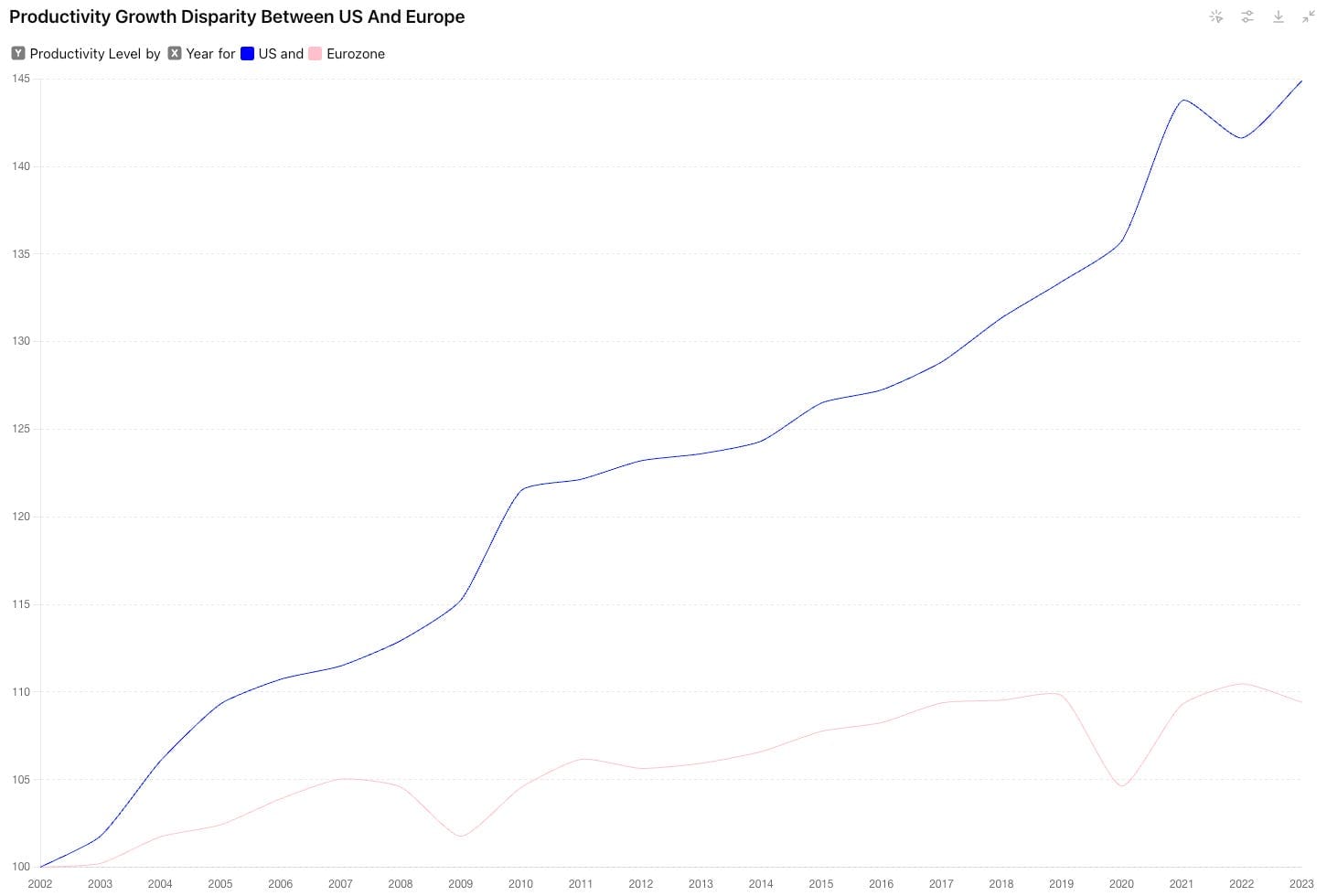
While public discourse often fixates on President Biden's age and occasional verbal missteps, a more profound concern has emerged among economists, industry leaders, policymakers, and market watchers: the economic implications of a second Biden term. The media's focus on emotional issues such as age and verbal stumbles, rather than underlying economic concerns is a disservice to the American people. To address this, we spoke with senior economists, policy experts, and market analysts to understand their reasons for wanting to replace Biden as the Democratic candidate. Their collective warning is stark: another four years under Biden could permanently damage the U.S. productivity growth engine.
Before you continue, please consider supporting our ongoing commitment to meticulous and independent political and business analysis through a subscription or one-time contributions, enabling the sustained delivery of such indispensable insights. Each of these reports costs us many tens of thousand dollars in time and travel. Your support and donations are essential in keeping our reporting independent.
This apprehension transcends partisan lines. Many of those interviewed, despite their reservations, remain Democratic voters, though their support is now tinged with hesitation and a noticeable lack of enthusiasm. "It's not about Democrat versus Republican," asserts a prominent economist who requested anonymity. "It's about the economic policies and their long-term impacts." These experts draw comparisons not with former President Trump, but with former President Obama, concluding that a change in leadership is necessary to safeguard the nation's economic future. The sentiment is in line with what we have been hearing from our contacts within the Silicon Valley and on Wall Street.
The contrast in economic management between the Obama administration and the current one is a key point of concern. As one industry leader noted, "During the Obama years, despite the Great Recession, we saw substantial productivity growth, which was crucial for recovery and long-term economic health. Biden's approach, however, has been markedly different and less effective."
Critics point to several areas where they believe the current administration's policies are falling short. They cite a shift towards expansive spending and increased government intervention as significant departures from the fiscal discipline seen during Obama's tenure. A policy analyst commented, "Biden's economic strategy mirrors European welfare states, which we know to be less effective at driving growth."
These critiques focus not on the goals of Biden's policies but on their implementation. A market watcher explained, "While some of Biden's initiatives address crucial societal needs, the scale and structure of spending risk crowding out private investment and stifling innovation."
The disquiet among these experts is palpable. They highlight a stark contrast in economic management between the Obama administration and the current one. "Obama, working with a Republican Congress, demonstrated fiscal discipline," notes a former Federal Reserve official. "Biden's approach is markedly different - characterized by expansive spending reminiscent of European welfare states."
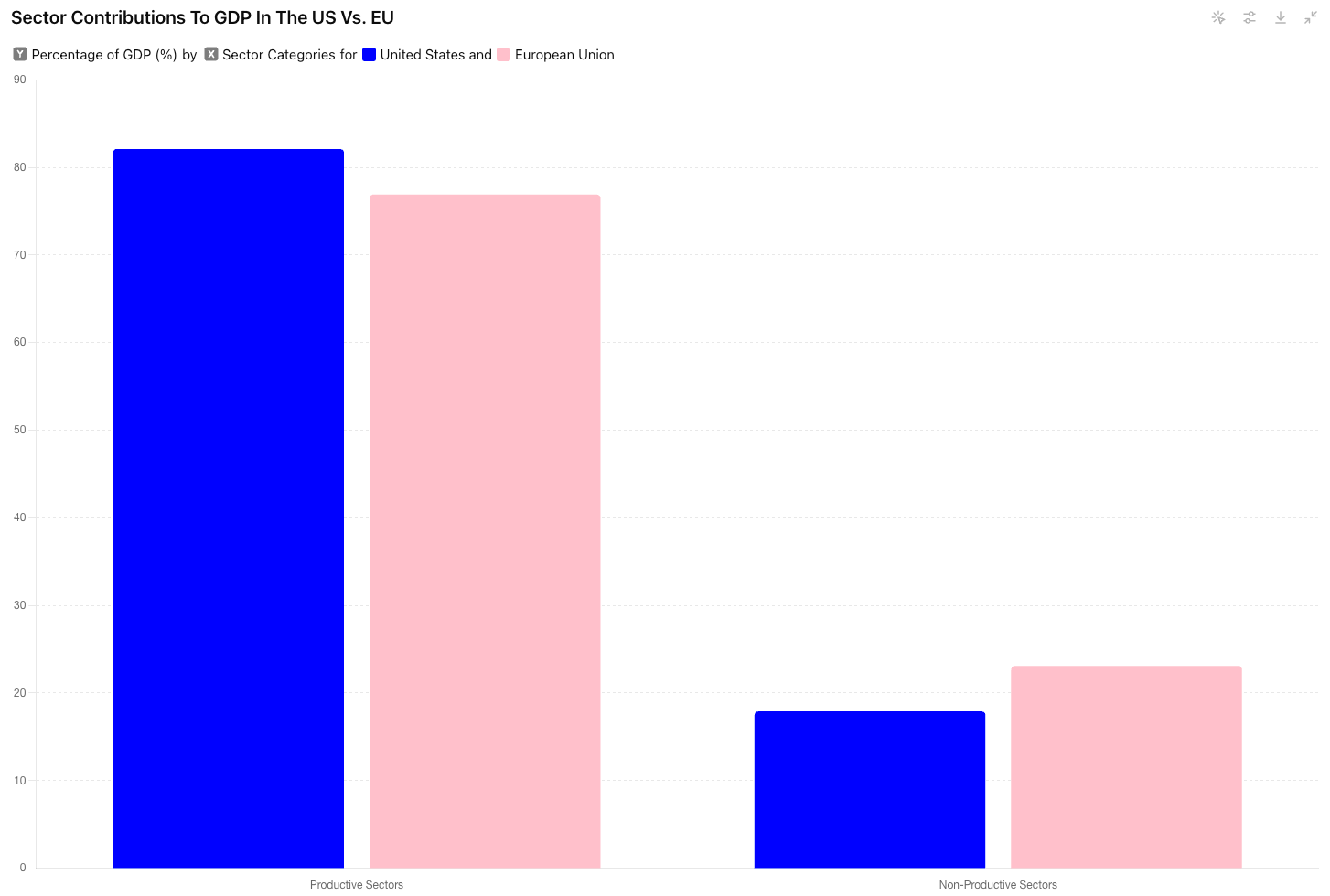
This shift is evident in the allocation of GDP. While Europe dedicates 5-6% more to non-productive sectors like healthcare administration and non-infrastructure government spending, the U.S. has historically channeled a greater proportion into discretionary R&D and investments. "This difference," explains a Wall Street analyst, "essentially provides the U.S. with four times the spending power for growth-boosting activities."
As the election approaches, the economic community's concern grows more vocal and unified. "The stakes are too high for complacency," another anonymous economist concluded. "The next four years could determine whether America maintains its economic leadership or slides into European-style stagnation."
The consensus among these experts is clear: the current trajectory under President Biden could undermine the economic dynamism that has historically characterized the United States. Their message to voters is one of caution and the urgent need for a reassessment of the nation's economic leadership. In a world where economic might increasingly equates to geopolitical influence, the ramifications of this shift extend far beyond U.S. borders. As voters head to the polls, they may well be deciding not just on a president, but on the future of the American economic model itself.
"We're witnessing a pivotal moment in U.S. economic policy," observes a senior fellow at a prominent think tank. "The current administration's approach bears a striking resemblance to European models, which have historically lagged behind the U.S. in terms of innovation and growth."
The Productivity Pendulum: From Obama's Surge to Biden's Stagnation
Over the past 16 years, the U.S. has experienced significant shifts in economic policy and performance, especially in terms of productivity growth. This era, spanning three presidential administrations, starkly illustrates how varying approaches to economic management can produce vastly different results.
During President Obama's tenure, despite the daunting task of recovering from the Great Recession, the U.S. economy achieved notable productivity gains. As one former economic adviser remarked in a 2016 interview, "We saw substantial productivity growth during the Obama administration, with increases of over 10% across his tenure. This growth was crucial in driving the recovery and setting the stage for long-term economic health."
The numbers tell a compelling story. While previous administrations saw significant productivity gains, recent data suggests a troubling reversal under the Biden-Powell leadership. Indeed, these economists put an equal blame on Chairman Powell as they do on Biden - but equally point out that Biden had the opportunity to replace Powell, which he didn’t take, even as inflation rose and productivity tanked under his watch. As they note, the post-pandemic productivity surge quickly dissipated once Biden and Powell started funneling money into an economy that was just starting to come alive, raising questions about the sustainability of current economic policies.
A former Treasury official notes, "The contrast with previous administrations is stark. We're seeing a departure from the fiscal prudence that characterized earlier years, moving towards a model of extensive government intervention and spending. As we emerged from 2008 crisis under Obama, for example, we did not go into a drunken spending spree that has been a hallmark of this administration,” remarks a senior economist under Obama administration, “The prudence ensured economy continued to prosper for many years, and as a result Obama handed Trump a booming economy.”
These productivity gains not only continued but accelerated under President Trump. Data from the U.S. Bureau of Labor Statistics reveals that productivity growth reached nearly 10% over Trump's four-year term, a pace unparalleled in recent decades. In a 2019 address, Trump himself celebrated this achievement, stating, "We have delivered an economic miracle. Productivity is through the roof, and we're just getting started."
The scenario under President Biden, however, has been markedly different. While there was an initial surge in productivity immediately following the COVID-19 pandemic, this gain proved short-lived. As one Harvard University professor and former economic adviser noted in a 2023 social media post, "The productivity boom we saw in 2020 has essentially evaporated. We're now seeing growth rates that are concerning, to say the least."
The implications of this shift extend beyond domestic concerns. In an increasingly competitive global economy, any erosion of America's productivity edge could have far-reaching consequences. "We're not just talking about GDP figures," warns an international economics expert. "This is about America's position as a global economic leader and innovator."
As the debate intensifies, there's a growing consensus among economists that the next four years will be critical in shaping America's economic future. "The choice before us is not just between political parties," emphasizes a prominent economist. "It's a choice about the fundamental nature of our economy and our capacity for continued leadership in an ever-evolving global marketplace."
The potential consequences of this shift are profound. A respected market analyst cautions, "If the current economic model persists, we might witness a decline in productivity growth reminiscent of European experiences. While short-term stimulus measures might provide temporary relief, the long-term impact on America's competitive edge could be severe."
This perspective is gaining traction across the political spectrum. Even those who support aspects of the administration's social agenda express reservations about its economic implications. "It's not about questioning the goals," notes a former chair of a presidential economic council. "It's about finding ways to address pressing societal issues without compromising the dynamism that has been the hallmark of American economic success."
As the election nears, the economic community appears increasingly united in its concern. "Complacency is not an option," concludes a leading economist. "The decisions made in the next four years could determine whether America maintains its position of economic leadership or risks sliding into a pattern of stagnation we've observed elsewhere."
Economists Concerns
A record low unemployment, inflation finally under check - why such doom and gloom, you would wonder. However, economists are known to look beyond the here and now and worry about the next 30-50-100 years. In their eyes, we are already approaching the doom cycle and need drastic steps to reverse the decline. Their concerns center on several key issues:
1. Productivity Stagnation: A former economic adviser noted, "The productivity gains we saw under previous administrations have largely evaporated under Biden. This trend, if continued, poses a significant threat to long-term economic growth and living standards."
2. Shift Towards European Model: Another economist warned, "The Biden administration's policies are nudging the U.S. economy towards a more European model. While this approach has its merits, it has consistently underperformed in terms of productivity growth and innovation."
3. Government Spending and Debt: A senior fellow at a policy institute stated, "The current trajectory of government spending and debt accumulation is unsustainable. It risks crowding out private investment and burdening future generations with a massive fiscal overhang."
4. Regulatory Environment: A professor of economics stated, "The increasing regulatory burden under the Biden administration is stifling innovation and entrepreneurship, key drivers of productivity growth."
5. Global Competitiveness: Finally, a Nobel laureate in economics cautioned, "As other countries, particularly in Asia, are streamlining their economies to boost productivity, the U.S. risks falling behind if it continues on its current path."
However, it's important to note that not all economists share this view. Another Nobel laureate argued in a 2024 piece, "While there are legitimate concerns about some aspects of Biden's economic policies, we must also consider the potential benefits in terms of reduced inequality and improved social outcomes. The challenge is finding the right balance."
Nevertheless, the prevailing sentiment among many economists is one of apprehension. A former vice chairman of the Federal Reserve summarized this view in a 2024 lecture: "The stakes in this election are extraordinarily high from an economic perspective. The next four years could determine whether the U.S. maintains its position as a global economic leader or slides into a period of prolonged stagnation."
The European Pivot: Implications of a Second Biden Term
“It is evident that the administration is looking to reshape economy. This shift is particularly evident in how national resources are allocated,” comments a Professor of economics at NYU. “Traditionally, the U.S. has directed a larger share of its GDP towards sectors that drive innovation and long-term growth. However, current trends suggest a move towards increased spending on what economists term ‘non-productive’ sectors.”
A former economic advisor to multiple administrations explains, "The U.S. has long outpaced its European counterparts in allocating resources to R&D and strategic investments. This advantage is now at risk, potentially diminishing our capacity for economic rejuvenation and technological advancement."
Indeed, we examined the share of spending in the US on so-called productive versus non-productive sectors. Non-productive sectors, such as administrative services and defense, do not directly contribute to economic production and act as a tax on the system. The more resources allocated to these activities, the less is available for growth and innovation. Since most economic activity is focused on providing goods and services, even small changes in non-productive spending can have a significant and compounding effect on the long-term health of the economy. An economy that minimizes waste prospers, while one that does not suffers.
While some defend the administration's focus on addressing social inequalities, others worry about the economic trade-offs. "Balancing social needs with economic growth is crucial," acknowledges an economist at a leading research institution, who was also a senior member of staff during the Obama administration. "However, the current approach may inadvertently stifle the very engines of prosperity that have historically funded social progress."
This sentiment is echoed by other prominent economists. One former Treasury Secretary and director of the National Economic Council expressed concerns in a 2023 interview, stating, "The current administration's approach to economic management is troubling. We're seeing a level of government intervention and spending that risks crowding out private investment and stifling the innovation that has historically driven U.S. productivity growth."
The contrast with previous administrations is stark. As one Nobel laureate in Economics noted in a 2024 column, "The Obama administration, working with a Republican Congress, managed to nurture economic growth while maintaining fiscal discipline. The current administration seems to be taking a different approach, one that bears more resemblance to European economic models than traditional U.S. policy."
This shift towards a more European-style economic model has raised alarm bells among many economists. One Harvard University economics professor warned in a 2023 article, "The U.S. has long outperformed Europe in terms of productivity growth, largely due to its more dynamic and flexible economic structure. The current trend of increased government intervention and spending risks eroding this advantage."
The concerns extend beyond academia. One prominent CEO, told us, "We're at a critical juncture. The policies of the current administration, while well-intentioned, risk undermining the very foundations of American economic dynamism. The explosion in government spending and increasing regulations are creating headwinds for productivity growth that could take years to overcome."
Even those who have supported some of the administration's goals express concern about their implementation. One Nobel laureate and former Chief Economist of the World Bank commented in a 2024 interview, "While I applaud the focus on addressing inequality and climate change, the current approach risks throwing the baby out with the bathwater. We need to find ways to address these crucial issues without sacrificing the innovation and productivity growth that have been hallmarks of the U.S. economy."
Looking ahead, the trajectory of U.S. productivity growth remains uncertain. What is clear, however, is that the decisions made in the coming years will have profound implications for the long-term health and competitiveness of the American economy.
The Economist's Dilemma: Why 'Anyone But Biden'?
“This isn’t about age, this isn’t about party - this is about a Presidency that’s undermining the very core of this economy,” told a Democratic lobbyist who has been making calls to restrict cash to DNC until Biden announces he won’t run again. As the 2024 election approaches, economists are increasingly vocal about the potential long-term consequences of a second Biden term. Silicon Valley and Wall Street magnets, however, are voting with the wallet.
One prominent economist wrote told us, "The policies pursued in Biden's first term, if continued, risk transforming the U.S. economy. We are going to kill American exceptionalism; many talk about lost decades - another four years of Biden policy will lose us the rest of the century."
Some economists argue that the short-term effects of Biden's policies might mask these longer-term concerns. A former chief economist at the IMF cautioned in a 2024 note, "While we may see a Keynesian boost in the short term, the long-term effects of this structural shift could be detrimental to America's competitive edge."
The tech sector, long a driver of U.S. productivity growth, has been particularly vocal about these concerns. In an interview, a Tech CEO told us, "The innovation ecosystem that has made America the global leader in technology is at risk. The current policy direction, if continued, could significantly hamper our ability to invest in cutting-edge research and development." This CEO has suspended all campaign contribution and is talking to various factions that are trying to unseat Biden, including Kamala Harris who has her own five-pillar strategy. “There is no question: I cannot contribute to this campaign and endure another 4 years of name-calling and vindictive policy-making,” they added.
However, not all economists view the shift negatively. A Nobel laureate argued in a 2024 note, "While there are valid concerns about productivity growth, we must also consider the potential benefits of a more European-style model in terms of reduced inequality and improved social outcomes. The challenge is to find a balance that preserves America's innovative spirit while addressing pressing social issues."
Nonetheless, the majority view among economists as well as industry seems to lean towards caution. A former chief economist of the World Bank summarized the sentiment: "If the Biden economic model takes hold for another four years, we could see a Europe-like decline in productivity growth. The implications for America's global competitiveness and long-term economic health could be severe."
The Soul of American Economic Identity
As voters prepare to cast their ballots, they face a choice that transcends traditional party lines. It's a decision about the fundamental structure of the American economy and its role in the global marketplace. The outcome of this election could shape the economic landscape for generations to come.
The American economy stands at a critical juncture. Concerns voiced by economists across the political spectrum reflect more than short-term policy disagreements; they speak to a fundamental questioning of the nation's economic identity and future trajectory.
A prominent economic expert encapsulated this sentiment: "The choice facing American voters is not merely between two candidates, but between two distinct economic philosophies. One seeks to preserve and enhance the dynamism that has long characterized the U.S. economy, while the other risks embracing a model that has led to stagnation elsewhere."
The data paints a stark picture. According to the Bureau of Labor Statistics, U.S. productivity growth, which surged by over 10% during the Obama years and accelerated further under Trump, has faltered under the Biden administration. This trend, if continued, could have far-reaching implications.
Another respected economist warned in a 2024 article: "The U.S. has long been the world's innovation engine, driving global productivity growth. A shift towards a more European-style economic model risks not just American prosperity, but global economic dynamism."
However, the debate is not simply about maintaining the status quo versus change. As a former Federal Reserve Chair pointed out in a 2024 address: "We must find ways to address pressing social issues and inequalities without sacrificing the innovation and productivity growth that have been hallmarks of the U.S. economy. This is the central challenge facing policymakers today."
The road ahead is fraught with challenges and uncertainties. The next administration, regardless of who wins, will need to navigate a complex economic landscape shaped by technological disruption, demographic shifts, and geopolitical tensions.
A Nobel laureate offered a nuanced perspective: "While there are valid concerns about the current economic trajectory, we must also recognize that economies are resilient and adaptive. The key is to foster policies that encourage innovation, investment, and productivity growth while also addressing societal needs."
As American voters head to the polls, they carry with them the weight of this economic crossroads. Their choice will resonate far beyond the next four years, potentially reshaping the foundations of American economic power and its role in the global economy.
In the words of a Harvard professor: "This election is not just about the next presidential term. It's about choosing the economic model that will define America's place in the world for decades to come. The stakes couldn't be higher."
As this analysis concludes, it's clear that the 2024 election represents more than a political choice; it's a referendum on the future of the American economic model. The outcome will not only shape domestic policy but will have profound implications for global economic dynamics in the 21st century.