
The Race to Dodge a 'Lost Decade'
Insider Voices Urge a Bold Pivot to Revitalize American Growth
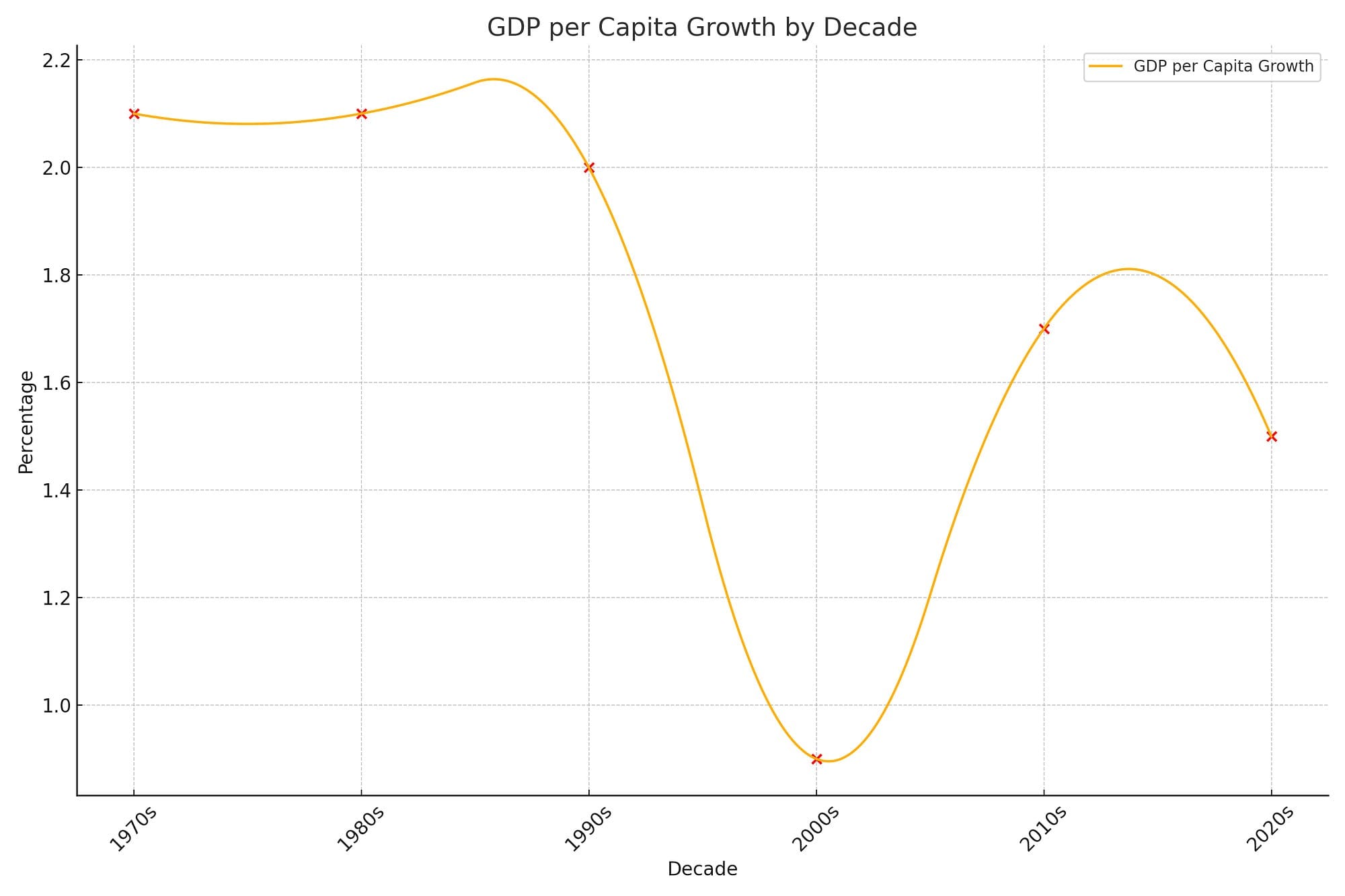
Our previous Report entitled The Biden Doctrine resulted in a lot of feedback from our readers: some suggesting a liberal tilt due to a point of view from the so-called liberal economists, while others suggesting rightward bias due to the conclusion that another four years under Biden would permanently damage the US economy. We rate our Reports on the basis of criticism we receive, and on that scale the story rated one of our highest.
To continue the conversation, we are bringing this Report with inputs not just from the economists but also the leading lights of Silicon Valley and Wall Street. Our panel cut across the party lines; indeed given the subject we weighed heavily to the Democratic leaders than the Republicans. The conclusion is largely the same: another four years under Biden will result in a "Lost Decade.” Many on the Democratic side are urging Biden to step down, but are not waiting to shift allegiance, as we reported in our prior Reports.
Strategic Insights Report is powered by our readers. We provide exclusive and comprehensive coverage of crucial yet often overlooked business developments, including our detailed economic analyses based on over 100 expert interviews. Subscribe today to join a community of forward-thinking professionals who depend on our indispensable business insights.
At an Economic Precipice: The Forewarnings of a 'Lost Decade'
As we evaluate the currents of the American economy through discussions with over fifty leading thinkers—from the realms of Silicon Valley innovation to Wall Street's financial mavens and academic circles—there emerges a complex forecast that is both cautiously optimistic and starkly cautionary. The thoughts shared by these pivotal economic players illustrate a nuanced landscape that transcends typical partisan divisions, challenging entrenched economic narratives.
One of the most striking revelations comes from drawing historical parallels that defy easy categorization. Treasury Secretary Janet Yellen’s comments in 2024 echo her optimism during her tenure as an economic advisor under President Clinton in 1999. “The Biden Administration has spearheaded a vigorous economic recovery,” Yellen noted, “with inflation receding by about two-thirds since its peak and unemployment holding below 4 percent for an unprecedented duration. The median wealth of American households has increased by 37 percent, and real wages have grown, enhancing overall purchasing power.”
These sentiments bear a strong resemblance to her remarks from 1999, when she observed, “Our nation’s economy is the strongest it’s been in a generation. Real GDP grew 3.9 percent, with about 2.9 million non-agricultural jobs added, and the average unemployment rate for the year dropped to its lowest level since 1969 at 4.5 percent. We witnessed robust growth, strong job creation, low unemployment, and stable, low inflation.”
However, a former Federal Reserve economist warns of the perilous undercurrents these optimistic assessments might mask. “It’s crucial to remember that shortly after Yellen’s 1999 comments, the economy encountered the dot-com crash, leading to what some economists call a 'lost decade,' exacerbated by costly military engagements,” the economist reflected. “Today, with the national debt surpassing $33 trillion—more than 120% of GDP—we see troubling parallels with the early 2000s’ steep debt accumulations that could presage similar economic turbulence.”
Echoing the timeless insight of Milton Friedman, “Inflation is always and everywhere a monetary phenomenon,” a prominent Yale economist highlighted that the current fiscal policies might be setting the stage for another economic downturn. “This administration’s approach, with a federal budget deficit ballooning to $1.7 trillion in 2023, is reminiscent of the early 2000s under Bush, rather than the Clinton or Obama years.”
Amidst these discussions, a Wall Street analyst offers a nuanced view, suggesting that, despite his divisive rhetoric, Trump's economic strategies showed practical similarities to those of Obama and Clinton. "Looking at the pre-pandemic average GDP growth of 2.5% during Trump's term, it aligns closely with Obama’s second-term average of 2.3%," he pointed out, challenging the binary political narratives often presented.
These reflections and historical insights foster a deeper understanding of the potential economic challenges ahead. As a venture capitalist who has supported over a hundred startups remarked, "We are at a pivotal moment. The decisions we make now will determine if we advance into a new era of innovation or descend into a decade of economic mediocrity reminiscent of the early 2000s following the dot-com burst."
The synthesis of past and present in these economic evaluations suggests that while the outlook might seem promising, underlying risks could derail the anticipated progress.
Echoes of the Past: Sounding the Alarm on Economic Parallels
The concerns articulated by our panel of experts resonate deeply with historical precedents. Many of them draw stark comparisons between today's economic climate and the early 2000s, noting similar patterns in government spending and initial growth that ultimately led to significant market corrections.
A seasoned Wall Street investor with decades of experience pointed out the troubling similarities: "The mix of factors we're observing now is eerily reminiscent of the conditions that preceded the dot-com crash. There's an excessive optimism in certain sectors, coupled with unsustainable government spending levels."
This sentiment is echoed by a former member of the Council of Economic Advisers, who noted, "The growth rate of the money supply currently receives little attention in the conduct of monetary policy, much like the early 2000s. We're overlooking critical economic indicators in favor of short-term growth."
The parallels extend beyond mere sentiment. A Silicon Valley venture capitalist highlighted, "In the late '90s and early 2000s, we saw a surge in speculative investments, particularly in the tech sector. Today, we see similar patterns with cryptocurrencies, AI startups, and other emerging technologies. The question is not if, but when, this bubble will burst."
A former Federal Reserve economist elaborated on the role of government spending, stating, "In the early 2000s, we transitioned from budget surpluses to significant deficits. Today, we're witnessing deficit spending on a scale previously unimaginable. We're setting the stage for significant inflationary pressures."
However, not all experts view the situation as dire. A professor of economics from a leading university offered a balanced perspective: "While there are undeniable parallels with the early 2000s, we must also recognize that the relationship between money growth and inflation is complex. As historical data suggests, even if a close relationship between money growth and inflation exists over the long run, it largely disappears at shorter time horizons such as a year or a quarter."
The potential for a market correction looms large in these discussions. A hedge fund manager known for predicting market trends warned, "Just like the early 2000s, today's market valuations, particularly in tech, are reminiscent of those precariously high levels. We could be setting ourselves up for a similar correction."
Yet, as a senior economist at a major bank pointed out, "If no close relationship emerges for the United States even over fairly long time periods, then that evidence would support ignoring money growth as an inflationary factor. We must be cautious not to draw overly simplistic parallels with the past."
The consensus among our panel is that while history does not repeat itself exactly, it often rhymes. Today’s economic conditions bear unsettling similarities to those leading up to previous downturns, suggesting we may be charting a course through similarly turbulent waters.
A Perfect Storm: Today's Economic Challenges Surpass Those of the Early 2000s
The landscape of today's economy, while reflective of past patterns, presents challenges that are unprecedented in their scope and potential impact. The concerns of our experts revolve primarily around the staggering levels of government debt and deficit spending, amplified by unique global economic pressures.
A former Secretary of the Treasury underscored the severity of the situation, "In the early 2000s, we were worried about deficits in the hundreds of billions. Now, we're grappling with trillions. Our national debt has surged past $33 trillion, over 120% of GDP, a debt-to-GDP ratio not seen since the Second World War."
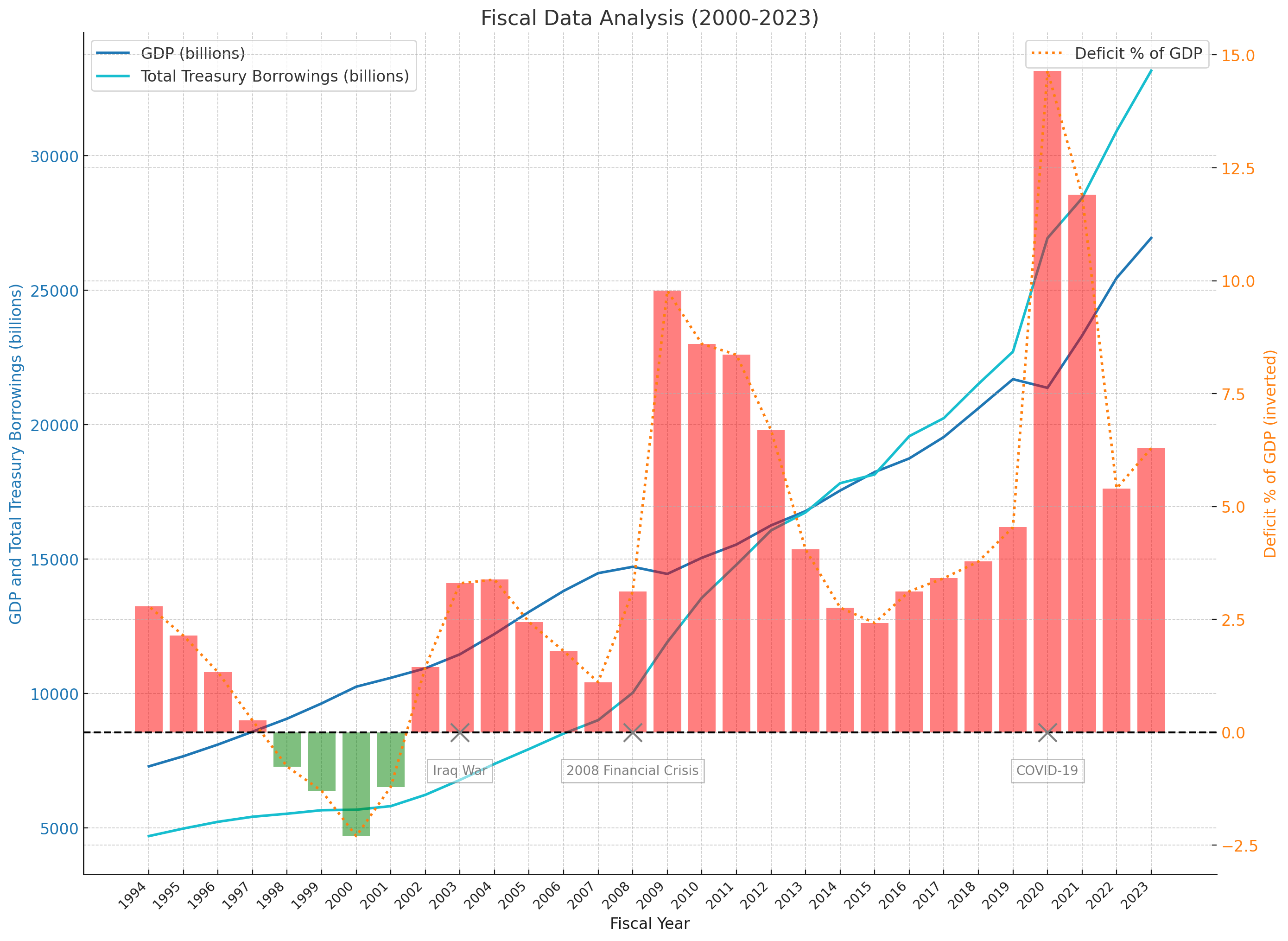
An economist at Yale pointed out that although Trump showed some proclivity for deficit spending, it was nothing like what Biden has shown. The economist shared this chart showing a concerning trend, opposite of Obama years, where deficit spending increased as a % of GDP in 2023, even as we have been fighting inflation. “This is quite unique and opposite of what we observed under Obama, who was bringing spending to a more normalized level after the financial crisis, unlike Biden who has shown a desire to spend more, not just in real terms, but as a percent of our economy.”
A prominent economist from the University of Chicago echoed this alarm, "The scale of government spending and monetary expansion today far exceeds what we witnessed in the early 2000s. As Milton Friedman warned us, 'Inflation is always and everywhere a monetary phenomenon.' We are potentially setting the stage for inflationary pressures that could prove more challenging to control than in previous decades."
The global economic context adds another layer of complexity. An analyst at the International Monetary Fund highlighted, "Unlike the early 2000s, we are now facing synchronized slowdowns in major economies around the world. China's growth is slowing, Europe is wrestling with energy crises, and emerging markets are burdened with debt. The U.S. cannot rely solely on global demand to buffer its economic challenges as it might have in the past."
The technology sector, often viewed as a growth engine, is also a source of concern. A veteran Silicon Valley venture capitalist warned, "During the dot-com era, overvaluation was largely confined to internet companies. Today, overvaluation spans multiple sectors, from AI and blockchain to renewable energy and biotech. The potential for a multi-sector correction is significantly higher."
Monetary policy's effectiveness is another area drawing scrutiny. A former Federal Reserve governor observed, "In the early 2000s, we had more flexibility with interest rates. Today, with rates already low and the Fed's balance sheet greatly expanded, our traditional tools for stimulating the economy are considerably constrained."
Labor market dynamics have also shifted, adding to the complexity. An economist specializing in employment trends noted, "Unlike the 2000s, we are now facing a unique combination of labor shortages in some sectors and potential job displacement due to automation in others. This complicates the Federal Reserve's mandate to maintain full employment while controlling inflation."
Yet, despite these daunting challenges, not all outlooks are bleak. A professor of economics from MIT provided a counterpoint: "While the challenges are indeed greater, our understanding of economic crises and our policy tools have also evolved. We have learned valuable lessons from past crises that can help us navigate these turbulent waters more effectively."
The collective insight from our experts suggests that today's economic challenges are not just a repeat of past difficulties but represent a new frontier that requires innovative thinking and decisive action to navigate successfully.
Charting a Course for Growth: The Case for Fiscal Restraint and Private Sector Innovation
As discussions about a potential "lost decade" intensify, a consensus emerges among our panel of experts advocating a dual approach to economic recovery: stringent fiscal restraint coupled with a robust promotion of private sector innovation and job creation. Our business-minded sources on the Silicon Valley had a simpler suggestion: “let Biden step down. The man has been in Government for 50 years, he thinks more Government is the answer to everything.”
A former Chair of the Council of Economic Advisers emphasized the urgency of fiscal discipline: "We need to return to the fiscal prudence of the 1990s. Under Clinton, we saw how a balanced budget could coexist with robust economic growth. The current level of deficits is unsustainable and crowds out private investment."
This perspective is reinforced by a noted economist from Stanford University, who remarked, "As Milton Friedman frequently argued, government spending is ultimately taxation. By curtailing federal expenditures, we can free up resources for the private sector to innovate and grow. The tech boom of the 1990s is a testament to the power of private sector-led growth."
The role of monetary policy in this context is critical. A former Federal Reserve governor pointed out, "While our monetary policy tools are more limited now, a clear commitment to price stability can provide the certainty businesses need to make long-term investments. From the late 1990s, we know that 'the Committee would have little confidence that money growth within any particular range selected for the year would be associated with the economic performance it expected or desired.' We need to create a stable macroeconomic environment."
Innovation and productivity growth are seen as the main drivers of a potential economic recovery. A leading Silicon Valley venture capitalist argued, "The internet revolution of the 1990s demonstrates what's possible when the government steps back and allows entrepreneurs to lead. Today, we have similar opportunities in AI, clean energy, and biotechnology. We need policies that encourage risk-taking and investment in these emerging sectors."
Labor market flexibility is another critical area of focus. An economist specializing in employment trends noted, "The gig economy and remote work are transforming the employment landscape. Policies that support worker retraining and mobility can help align the workforce with the evolving job opportunities, much like the adjustments we saw during the 1990s tech boom."
However, some experts caution against an overly simplistic approach. A Yale economics professor advised, "While reducing government spending is crucial, we must ensure not to cut back on investments in education, research, and infrastructure that are essential for long-term growth. As we learned from the 1990s, 'Knowing the length of the long run is important for current policymaking.'"
The global economic landscape also plays a pivotal role. A former Undersecretary of the Treasury for International Affairs remarked, "In the 1990s, we benefited from a global peace dividend and burgeoning international trade. Today, navigating a more complex geopolitical landscape requires policies that promote free trade and international cooperation."
Despite the challenges, there is a current of optimism among many experts. A senior economist at a major tech company pointed out, "The U.S. economy has demonstrated remarkable resilience in the face of past crises. As seen during the 1990s and after the 2008 financial crisis, American innovation and entrepreneurship can spur significant recoveries under the right conditions."
The consensus among our panel suggests that averting a "lost decade" will require a delicate balance of fiscal restraint, monetary prudence, and policies that unleash the full potential of the private sector. As one venture capitalist succinctly put it, "We're at a crossroads. The path to sustained growth lies in creating an environment where the next wave of American innovation can flourish, just as it did in the 1990s. The government's role should be to set the stage, not to be the star of the show."
Navigating Uncertain Waters: The Path Forward
As we conclude our exploration of the economic challenges facing the United States, our panel of experts offers a sobering yet insightful synthesis of the issues at hand and the strategic responses required. The specter of a "lost decade" looms large, yet there exists a potent potential for a renaissance in economic policy and growth, contingent on significant shifts in leadership and policy direction.
A synthesis of expert opinions reveals a stark observation: the current administration's strategy, heavily focused on expansive government spending, mirrors not the successful economic stewardships of Clinton or Obama but rather the deficit-laden years of the Bush administration. "The approach we're seeing now—significant government expansion and intervention—is reminiscent of periods that led not to sustained growth but to economic vulnerabilities," noted a former economic advisor from the Reagan era.
Many experts express a growing consensus that a change in leadership could catalyze a more favorable economic trajectory. The suggestion that President Biden might step aside for new leadership has gained traction among economic circles concerned with the current fiscal policies. "It’s perhaps time for a leadership that can invoke the pragmatism of past successful administrations without being wedded to continuous government expansion," suggested a political strategist.
In envisioning a more dynamic and competitive political landscape, some experts propose a scenario where figures such as Michelle Obama, known for her pragmatic approach similar to that of her husband, could offer a refreshing contrast in a potential electoral bout against figures like Donald Trump. Such a matchup could invigorate democratic processes and lead to economic policies more in tune with robust economic management rather than mere fiscal expansion.
"The ideal scenario would involve leadership that not only understands the intricacies of economic policy but can also implement a vision that includes fiscal restraint coupled with strategic investment in innovation and infrastructure," remarked a senior fellow at a leading economic think tank. "Michelle Obama represents a blend of charisma, pragmatism, and a proven track record of advocacy for broad-based economic inclusion, which could be pivotal in steering the country towards sustainable growth."
Moreover, the dialogue among our panel underscores the need for a reevaluation of economic priorities and policies that extend beyond traditional party lines. "What we require is a recalibration of fiscal policy—moving away from blanket government spending towards targeted, impactful investments that stimulate private sector growth and innovation," explained an economist from MIT.
The path forward, fraught with challenges, also holds the promise of transformative economic reform. The consensus suggests that navigating these turbulent economic waters will require not only adept leadership but also a bold reimagining of fiscal strategies and a commitment to harnessing the innovative potential of the private sector.
As we stand at this critical juncture, it may play out a few different ways. Biden may decide to step down, creating a momentum behind whoever replaces him. In an alternative universe, Trump may win the 2024 elections. Given the current polling, it is highly likely we will see a change to the current policy of extremely high deficit spending. Would we return to the years under Clinton when we saw growth paired with surpluses? We think that’s unlikely in the short term, but we hope and expect to see a moderation that may just save our economy.
The decisions made in the coming months will undoubtedly shape the economic landscape of the next decade. It is a moment ripe for profound change, calling for a leadership that can transcend conventional boundaries and spearhead a new era of economic prosperity. The choice, ultimately, is ours.