
Trump 2.0: Going After South Korea
Trump team's white-paper suggests increased tariffs on Korean products
Most political coverage since “The Debate” has focused on domestic implications with various Democratic politicians angling for the top job. We think this is wrong, as the impact if Trump 2.0 materializes will be larger on economy and geopolitics and such analysis is necessary beyond the cliches and outsize rhetoric. Our prior coverage had identified brewing concerns within Democratic circles, highlighted in articles such as The Changing Politics of Silicon Valley, The Quest for a New Obama, and The Manhattan Whispers: Trump's Silent Surge. These articles, published before the debate, pinpointed shifts that other outlets are only now starting to address, noting the hesitancy among the Democratic elite to vote Biden-Harris.
Cyber Sec Insider Report is a reader-supported publication. To receive new posts and support my work, consider becoming a free or paid subscriber.
Today, we are shifting our focus to policy implications of a potential Trump 2.0 administration, with an emphasis on South Korea. Today's report should be interesting to both our business as well as political readers, as this topic will impact both. We plan to provide similar coverage for Biden 2.0 as well.
While most are fixated on China, our analysis today turns to South Korea, which has continued to grow as an important trade partner. This redirection exposes stark contrasts between the Biden and Trump administration’s approaches to Asia. Both administrations recognize the strategic necessity to counter China, but their methods vary significantly. The Biden administration sees alliances with South Korea and Japan as crucial, while Trump’s policies are guided by "America First" principles.
Drawing from a variety of sources—including South Korean lobbyists, senior executives, and insiders within Trump’s policy sphere—our investigation has unearthed concerns detailed in a confidential white paper. This document positions South Korea not as a crucial counterbalance in the region, but a threat to the US economy in the same vein as China.
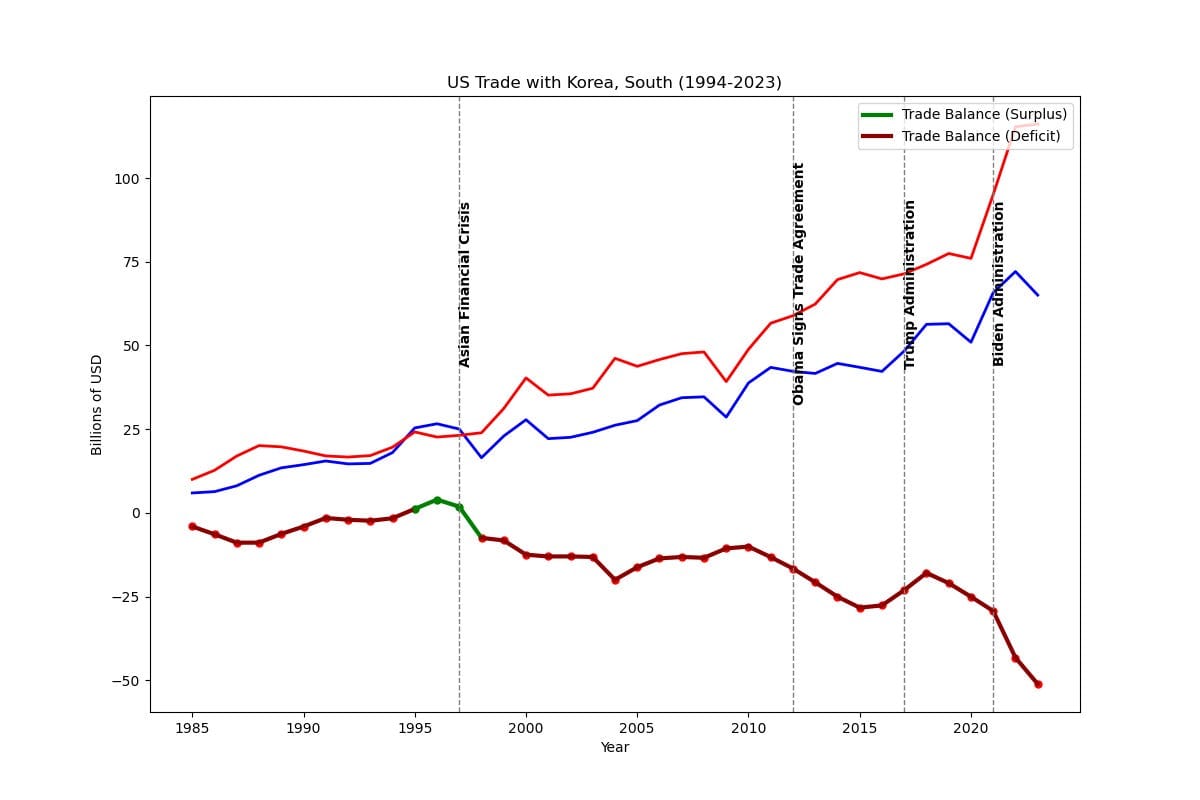
The white paper states, "While we recognize the importance of South Korea as a trade partner, their recent aggressive trade practices have exploited the leniency of the Biden administration. We are committed to restoring a balanced trade relationship with South Korea." It goes on to note that the last instance of balanced trade between the two nations occurred in the late 90s, during the Asian currency crisis. A Seoul-based expert, who had previously predicted the currency crisis, expressed concerns: "Although South Korea's economy is currently much stronger, attempting to force a trade balance could precipitate another economic crisis."
"The recent debate wasn't just a political spectacle; it stirred the undercurrents of international trade and diplomacy, unsettling key sectors in South Korea," an academic expert noted, emphasizing a concern that’s largely been ignored by the US press.
Polling data now shows a tighter race than expected, with Trump gaining traction, a development that has surprised many and caused unease among stakeholders in the thriving U.S.-South Korea trade relationship, painstakingly nurtured under previous U.S. administrations.
"The community is on edge," expressed a leader in the Korean-American business community. "The solid growth we've enjoyed is now threatened by the resurgence of isolationist policies."
Our research reveals that the South Korean lobby is gearing up to counteract potential policy changes that could impact them significantly, disproportionate to their apparent size. They are bracing for possible increased tariffs, stricter trade regulations, and disruptions to established agreements. In response, they are ramping up their political engagement, with substantial donations into the millions reaching Democratic super PACs. However, not all feel included in this strategy. A novice executive in political activism expressed their uncertainty, saying, “I know they don’t need my money in California, but I'm at a loss about where else to contribute.”
A US-based businessman of South Korean descent emphasized the stakes involved, noting, "The economic landscape in South Korea has thrived under the current U.S. trade policies. Trump-tariffs could lead to significant disruptions," underlining the concerns about potential measures under discussion.
Korean policymakers and executives are even more concerned: "We are already in a hole with falling Chinese exports, if the US also adjusts its policy stance, South Korea will certainly go in a recession in 2025," commented a geopolitical strategist based out of Seoul.
U.S.-Korea Trade Relations: The Shift with KORUS FTA
The trade dynamics between the U.S. and South Korea transformed fundamentally with the launch of the U.S.-Korea Free Trade Agreement (KORUS FTA) in 2012, during President Obama's administration.
Dr. James Park, an expert in U.S.-Korea relations, comments on the significance of the agreement: "KORUS FTA dramatically redefined America's economic engagement in Asia, akin to the impact of NAFTA in earlier decades and triggered a secular increase in trade, especially the imports. Just as we saw with NAFTA, the export gains came, but never equalled the increase in imports."
This agreement significantly reduced tariffs across multiple sectors, including technology, automotive, and agriculture, aiming to enhance trade in these areas. Korean companies saw their share of American markets increase, with Hyundai and Samsung as some of the key companies that gained during this period.
The path to this agreement was fraught with challenges. It began under President Bush in 2006 and met considerable opposition. U.S. auto workers feared job losses, while Korean farmers resisted opening their markets to American agricultural products.
Despite these obstacles, the agreement succeeded in boosting trade significantly. By 2019, U.S. exports to Korea had increased to $65.8 billion from $43.5 billion in 2011, with Korean exports to the U.S. experiencing similar growth.
Under the Trump administration, trade policies continued along similar lines, albeit with occasional rhetoric suggesting otherwise. “As with its China policies, Trump 1.0 suffered from being undermined by establishment, resulting in a lack of action. While we tried to improve the balance, these detractors limited the impact of Trump policies,” commented a Trump campaign insider.
U.S.-Korea Trade Under Trump and Biden
US-Korea trade relationship haven’t always been smooth. Issues such as U.S. complaints about Korean restrictions on beef imports and Korean concerns over American steel tariffs have persisted. These tensions intensified when the Trump administration demanded a renegotiation of KORUS, claiming the original terms were unfavorable to American workers. The 2018 amendments focused on boosting U.S. auto exports and maintaining tariffs on Korean trucks, aligning with Trump's "America First" policy.
Dr. Lisa Kim, a trade specialist, reflects, "The amendments under Trump were designed to secure American advantages, treating trade deals as zero-sum games."
Under President Biden, however, Korea has become a large counterbalance to China and a key ally in Asia. Trade with Korea, particularly in imports, saw a significant increase. "The Biden administration has strengthened this trade relationship, relying on Korea as a key ally, sometimes overlooking the re-export of Chinese goods," a policy expert noted.
With the possibility of Trump’s trade policies making a comeback, there are concerns about the stability of this partnership. "A shift back to Trump's confrontational trade policies could significantly disrupt U.S.-Korea economic relations and affect the broader region," states a former State Department official.
The trade relationship between the U.S. and South Korea has seen contrasting phases under the last two U.S. presidents, with a period of steady growth during Trump’s tenure and a more dynamic expansion under Biden. A rhetoric largely unmatched with policy under Trump to an invitation to aggressively increase South Korean imports under Biden.
During Trump's time in office, the trade dynamics between the U.S. and South Korea experienced consistent, albeit modest growth. "The actual impact of the Trump administration on U.S.-Korea trade was more muted than anticipated, yielding steady yet unspectacular growth," notes an economist from a leading international economics institute.
Official trade figures confirm this, with U.S. exports to South Korea slightly increasing from $65.8 billion in 2016 to $67.3 billion in 2020, and imports from South Korea growing from $71.8 billion to $77.2 billion during the same timeframe.
A former Commerce Department official remarked, "The 2018 renegotiation of the KORUS FTA introduced some sector-specific adjustments, notably in the automotive sector, but the broad trade relationship remained largely steady."
The advent of the Biden administration marked a significant shift, emphasizing enhanced ties with South Korea, especially against the backdrop of China's growing influence in the region.
A professor of International Political Economy comments, "There’s been a significant drive under Biden to bolster economic relations with South Korea, especially in high-tech industries, which has significantly boosted trade volumes."
By 2022, U.S. exports to South Korea had escalated to $78.4 billion, while imports surged to $109.8 billion—a substantial increase from previous years.
"The marked increase in Korean exports to the U.S. can be attributed to several factors: heightened demand for Korean tech products, a strategic shift away from Chinese suppliers, and significant Korean investment in U.S. production facilities," explains a chief economist from a noted economic research firm.
However, this boom has introduced challenges. "The rapid increase in Korean exports to the U.S., coupled with a less pronounced rise in U.S. exports to Korea, has led to a growing trade deficit, raising some concerns," an official from the U.S. Trade Representative's office pointed out.
This burgeoning deficit has sparked discussions about reevaluating the trade terms with South Korea. A former Trump administration trade advisor asserts, "The trade data clearly indicate that Korea is benefiting more from our relationship than we are. Rebalancing may be necessary."
Critics argue for a more comprehensive perspective. "It's essential to look beyond just goods trade to include services, investment flows, and the overall strategic benefits of our alliance," a professor emphasizes.
As the 2024 election draws near, the contrasting trade policies towards South Korea championed by Trump and Biden are likely to emerge as a pivotal issue. Voters are presented with a decision: either continue with Biden’s approach, which emphasizes strengthening alliances, or shift towards Trump’s more confrontational stance aimed at correcting trade imbalances. Additionally, Trump’s policy proposes a significant reshaping of the traditional trade playbook, a change that analysts and voters alike may not have fully considered in their evaluations.
Trump Team Suggests Hefty Tariffs on South Korean Imports, Stirring Trade Concerns
The policy team of former President Donald Trump has drafted a white paper that suggests imposing significant tariffs on South Korean goods, signaling a potential shift back to the aggressive trade policies that marked Trump’s first term. This proposal aligns with the "America First" doctrine and specifically targets pivotal South Korean industries including semiconductors, automobiles, and steel.
This approach starkly contrasts with the current administration's strategy, which has focused on strengthening ties with South Korea to mitigate China’s growing influence in the region.
A former Trump administration advisor highlighted, "There's a sense that South Korea has been given too much leeway in trade practices for too long. This white paper marks South Korea as a new focus in the quest for what is perceived as fair trade."
The document accuses South Korea of currency manipulation and facilitating ways for Chinese manufacturers to bypass U.S. tariffs. It suggests that South Korean companies engage in minimal processing of goods before exporting them to the U.S., exploiting loopholes in the current tariff system.
An expert on Korea from an important policy institute warned about the broader impact of such policies, noting, "This could severely damage one of the United States' most crucial alliances in Asia, with significant geopolitical fallout."
The potential policy shift has alarmed both diplomatic and economic circles. South Korean officials, who preferred to remain unnamed, expressed dismay: "This proposal undermines the decades-long alliance between our two nations."
Financial markets are bracing for potential turmoil, with a hedge fund analyst observing, "We could see a significant downturn in the markets and Korean Won could experience a decline versus the US Dollar similar to recent movements in the Japanese yen. Major Korean corporations like Samsung and Hyundai might face substantial challenges if they lose access to their most lucrative trade partner."
A chief economist from a large investment bank warned of broader repercussions, "If these tariffs are implemented, they could disrupt global supply chains, particularly in technology, and lead to increased prices for U.S. consumers across various sectors. While the US will be able to weather the impact, Korea may fall into a recession."
The white paper also criticizes the current military cost-sharing agreement with South Korea, arguing that despite recent negotiations, South Korea's contributions are insufficient.
As this policy proposal comes under scrutiny, it is set to be a hot topic in upcoming electoral debates, illustrating the stark differences between Trump's unilateral trade policies and the Biden administration's emphasis on alliance-building and diplomatic engagement.
An expert in International Relations from a renowned university remarked, "This proposal is classic Trump, aiming to rally his base by prioritizing American industries and jobs, even at the cost of straining long-standing alliances."
With the global community, especially Seoul and Washington, closely monitoring these developments, South Korea’s response will be crucial. The country may either acquiesce to U.S. demands or enter a new phase of intensified diplomatic tensions. The outcome of this policy could significantly alter both economic and security landscapes across Northeast Asia.
The Trump team's white paper signals a tough stance on what it views as South Korea's unfair trade practices, possibly heralding a significant escalation in trade disputes. The document targets several vital sectors, pinpointing them for potential tariff hikes due to their economic significance and perceived roles in creating trade imbalances.
Semiconductors:
The semiconductor sector, particularly memory chips, is a primary target. "Companies like Samsung and SK Hynix, which lead the global memory chip market, have been identified as competitors where the U.S. seeks to regain its market lead," states a technology policy expert from MIT. An insider from the Trump campaign suggests, "These companies have purportedly gained an edge through substantial government subsidies. Imposing tariffs could help level the playing field."
Automotive Sector:
The success of Korean automakers like Hyundai and Kia in the American market is also under scrutiny. An automotive industry analyst explains, "Their increasing market share has caught the administration's attention. Tariffs could significantly affect their competitiveness in the U.S." The white paper hints at possible tariffs of up to 25% on Korean auto imports, a figure that mirrors previous tariffs on European car manufacturers.
Steel and Electronics:
These foundational industries of Korea's export economy face potential challenges as well. "The steel sector has been a frequent subject of dispute, with ongoing claims that Korean manufacturers benefit from disproportionate government support," a trade lawyer specializing in U.S.-Asia relations comments.
Currency Manipulation and Connections with China:
The white paper also accuses South Korea of currency manipulation to unfairly benefit its trade position, an assertion met with skepticism. "Accusations of currency manipulation need solid evidence, which seems lacking here," an economist from the Peterson Institute comments, suggesting the claims might be more politically motivated than based on economic facts.
Moreover, the document raises concerns over Korean firms forming joint ventures with Chinese companies. "These collaborations are supposedly a strategy to minimally process products in Korea before exporting them to the U.S., circumventing tariffs on Chinese goods," a professor of international political economy remarks. This move indicates an attempt by the Trump administration to tighten loopholes in the current tariff regime involving China.
A Korean trade official strongly refutes these claims: "Our companies adhere strictly to international trade laws. These accusations appear to be a groundwork for justifying protectionist measures."
The looming possibility of new tariffs on South Korean goods has sent ripples of concern across Korean industries. "These tariffs threaten more than just immediate costs; they cast shadows of uncertainty over our economic projections," observes the leader of a major Korean business association.
The implications of such a policy change are profound, potentially reshaping the economic terrain not only between the U.S. and South Korea but across the entire Northeast Asian region. The international community is on edge, pondering how these developments might realign global trade dynamics.
The proposed tariffs could ignite a trade conflict with far-reaching consequences. "Implementing these tariffs could trigger a trade war, with severe repercussions for global supply chains," warns an international economics professor. Meanwhile, financial markets are already feeling the pinch, with notable volatility and declines in the stocks of key Korean exporters, particularly in the semiconductor industry.
This policy shift comes at a sensitive time in global politics, risking the undoing of years of diplomatic efforts aimed at containing Chinese influence in Asia. A senior policy strategist notes, "Such moves could inadvertently push South Korea closer to China, altering regional alignments."
The reaction in Seoul ranges from surprise to betrayal, with officials and business leaders expressing dismay over what they see as a reversal of a mutually beneficial economic relationship. "We're forced to consider all options, including diversifying our production sites and scaling back U.S. operations," states the CEO of a leading Korean tech company.
Election Implications: Navigating U.S.-Korea Relations
As the 2024 U.S. presidential election approaches, trade relations with South Korea may become a significant issue. The Trump campaign is doubling down on its "America First" rhetoric, believing that stringent trade policies will resonate with voters. In contrast, the Biden campaign is expected to emphasize the value of maintaining strong international alliances and stable trade practices. Despite its critical nature, the Korea trade issue might play second fiddle to the larger narrative focused on China, where both parties strive to demonstrate tougher stances. Yet, we believe these small undercurrents are what will win or lose the election. In our discussions, we heard from several South Korean executives who have increased their political givings, possibly influencing the election outcomes through targeted fund-raising efforts. In our conversations, we heard enough hints to think there’s a there there. In an election where margins may be razor-thin, even smaller, influential groups could provoke unexpected swings - we think both parties would ignore this group at their peril.
"We're at a pivotal moment that could redefine the future of U.S.-Korea relations and impact the broader Asia-Pacific security architecture," reflects a geopolitical expert. "The stakes are monumental… especially if you are South Korea."
We think the stakes could end up being monumental for the US, too.