
Intrigue in the cyberland
Cloud security leader attracts acquisition interest from larger players
Introduction to Zscaler
Zscaler is a pioneer in cloud security, providing a comprehensive platform aimed at protecting organizations from cyber threats. Established with the mission to enable secure digital transformations, Zscaler’s services adhere to the Zero Trust principle, ensuring no user or device is trusted by default. Its suite of products, including Zscaler Internet Access and Zscaler Private Access, offers advanced solutions ranging from threat protection to data privacy.

Zscaler's Products and Competitive Landscape
Zscaler delivers several key services:
Thanks for reading Cyber’s Substack! Subscribe for free to receive new posts and support my work.
1. Zscaler Internet Access (ZIA): This secure internet gateway provides advanced threat protection, data protection, and access control for users accessing the internet and cloud applications.
2. Zscaler Private Access (ZPA): A Zero Trust Network Access solution that offers secure, direct access to private applications without the need for traditional VPNs.
3. Additional Services: These include Zscaler Digital Experience and Zscaler Workload Communications which enhance user experiences and secure cloud communications, respectively.
Competition: Zscaler faces stiff competition from Fortinet's CASB solutions, Citrix Gateway, Symantec CloudSOC, and Cisco Umbrella, each providing overlapping services that challenge Zscaler in various domains.
Financial Performance and Strategic Acquisitions
Since its IPO in March 2018, Zscaler has shown impressive financial growth with revenue rising to $1.09 billion in FY 2023, a 62% year-over-year increase. Strategic acquisitions such as Edgewise Networks and Trustdome have expanded its capabilities in cloud security. With market capitalization a little over half of the $51 billion it reached in November 2021, Zscaler is for once undervalued in a frothy Software as a Service (SaaS) sector, consistently beating rule of 40. While Zscaler has yet to generate positive GAAP net income, with an operating margin of over 80%, and a free cash flow of 20+%, it can turn profitable at will. Given these factors, the deal could be structured to be accretive to any of the potential acquirers.
Table 1: Revenue and Billings
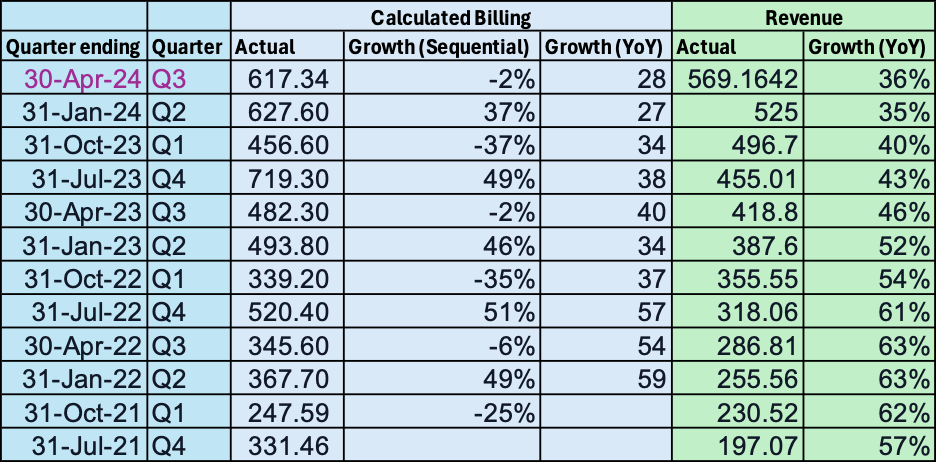
Note — April 24 (upcoming earnings) are projected based on our proprietary model. While not part of the overall note, we do expect Zscaler to bill significantly above its conservative guide. This is not an aberration, either, as both government and enterprise spending to remain strong throughout the year. These estimates represent a 5% beat on both billing and revenue compared to guide.
Not to give away the secret sauce completely, we should still break down how we arrived at these estimates. For Billing, we have used channel checks as well an analysis of number of openings related to implementation along with a normalized employee growth to come up with the estimate. Competitor results suggest a robust selling environment for SASE. Revenue is a lot more straight-forward and can be estimated to a fair degree of certainty by extrapolating prior billing and a few other inputs. We think hiring Mike Rich from Servicenow was a signal to the market that Zscaler is no longer satisfied being a $1–2 billion dollar ARR company. We expect growth to not only hold up but accelerate. Don’t rule out material growth acceleration in EMEA and APJ. Although we have access to sources internally who could confirm these numbers, we avoid using inside information for our fundamental research and reporting.
Strategic Fit with Potential Acquirers
Broadcom
Broadcom’s acquisition strategy may be pivoting towards software and cybersecurity, to support its Symantec cybersecurity business. This would provide a nice balance to its AI and networking business. Here's how Zscaler could fit into Broadcom's strategy:
- Complementary Technology: Zscaler's Zero Trust Exchange would mesh well with Broadcom’s existing network security and SASE solutions, providing comprehensive cybersecurity across various layers.
- Growth and Market Expansion: Zscaler offers a promising growth avenue for Broadcom in the cloud security market, which is critical as Broadcom seeks to cement its role in enterprise software and cybersecurity. Broadcom is second to none in its channel sales, which would benefit Zscaler expand.
- Enhanced Competitive Position: This acquisition would bolster Broadcom's cybersecurity offerings, making it a more formidable competitor in the industry.
Main concern would be the current integration of VMware underway. There are also some questions around duplicate portfolios, but we believe such concerns ignore that Zscaler services operate at over 80% gross margin. Based on what we have been told, Hock Tan remains motivated to create a substantial moat around Software as a Service (SaaS). We believe Broadcom can bring Zscaler to its peak valuation if not more by activating its channel sales and take advantage of Zscaler’s high margin business.
Microsoft
Microsoft could significantly benefit from Zscaler's cloud-native security capabilities, particularly in enhancing its Azure and Microsoft 365 services:
- Cloud and Enterprise Security: Integrating Zscaler could improve the security features of Azure, making it a safer platform and thereby attracting more users.
- Strategic Government and Enterprise Integration: Zscaler’s solutions would bolster Microsoft's offerings for government and large enterprise clients, where high security and compliance standards are crucial. Particularly on the Government side, breaches in prior years have put a strain that Microsoft would love to smooth out.
Key concern for Microsoft in the current environment remains the aggressive posture Biden administration has taken against large deals. However, we believe this deal will be approved to bolster cybersecurity, as Government looks to a cleaner integration between Microsoft and Zscaler products, both of which are used heavily within most agencies.
Cisco
Cisco’s strategy could be invigorated by acquiring Zscaler, adding a high-growth cloud security platform to its portfolio:
- Enhancing Cisco's Security Offerings: Zscaler's technologies would complement Cisco Umbrella and other security products, filling crucial gaps in Cisco’s security landscape.
- Operational Synergies: Despite potential challenges in integration, Zscaler's cloud-native solutions could be more seamlessly adopted into Cisco's ecosystem compared to other acquisitions.
Cisco’s cash position may prove to be a concern. However, given strong cash-flow Zscaler generates, this may be manageable with the right deal structure.
Market Impact and Predictions
An acquisition of Zscaler would significantly alter the cybersecurity landscape, enhancing the acquirer's product offerings and customer base. Given the current market dynamics, Zscaler appears as an attractive target. We anticipate a potential deal by summer as strategic assessments and due diligence are completed. This will significantly impact others such as Palo Alto and Fortinet. Depending on the buyer, it may be net positive or negative for Crowdstrike. Given we expect Broadcom to come out on the top, there are chances that the current partnership Crowdstrike has with Zscaler may be impacted negatively. Long term, Palo Alto and Fortinet may benefit from the acquisition if Broadcom takes its well-known strategy of focusing the acquisition and raising the pricing. We expect a deal if closed to price Zscaler common shares at around $235-$260 range, which is a discount from its all-time high, but 30% premium to its current trading-range.
Conclusion: Anticipating a Strategic Acquisition
As we monitor the developments around Zscaler, the potential acquisition by Broadcom, Microsoft, or Cisco could redefine competitive dynamics in the cybersecurity sector. Each company would benefit in unique ways, enhancing their capabilities and market position. As noted earlier, Broadcom remains in best position to seal the deal. It has a strong incentive to strengthen its weakening cybersecurity business and build a substantial large-scale business. The next few months are crucial as this strategic shift could set new industry standards in cybersecurity solutions. A much bigger underlying story is how the consolidation wave may be getting kicked off. We don’t believe this will be the last large deal in this space and we also expect others such as Alphabet getting in the game to meet competitive pressures. Stay tuned!
Thanks for reading Cyber’s Substack! Subscribe for free to receive new posts and support my work.